Children fidgeted on the miniature furniture, a few strained against their parents’ grip, trying to make a dash for the door. Many wept on that first day of kindergarten. Not my daughter. Her perky-pigtails pointy straight up like two exclamation marks over her bright eyes, she comforted her new classmates. Unlike these timid ones, she wanted me to leave so she could get on with this new chapter of her life. Without me. Already, she was in command of the situation, sure of how she might fit in, ready to lead the way.
I was the one who wavered, lingering at the door not quite ready to separate. She offered a quick hug and wet kiss and turned back to reassuring the inconsolable blond boy next to her. I walked down the long hallway and out of the school. In my gut, my aching gut, I knew that in some huge way, she was no longer mine. In my car, I put my forehead on my steering wheel and sobbed.
It wasn’t like this separation business was new to us – she was in full time daycare from the age of two. But kindergarten, her first day in mandated school, felt different. She became part of the education machine that would define her, arguably, in as fundamental a way as me. Bereft and with tears still flowing, I drove away from what would become, her beloved elementary school. Her world without me had begun.
Well, not quite. Waking her up, making breakfast, lunches, homework, studying, play-dates, violin lessons, plays, sports games, concerts — the requirements an endless list of juggling and challenges over the years. Still, I was a stage hand, providing the behind-the-scene assistance for the Molly show. And she was a star throughout the years.
Last week she graduated from high school. Her name in the program followed by real stars marking her achievement. I’m terribly proud of her of course, but I also feel a sense of accomplishment of my own that surprises me. While she is pretty self-motivated, I get to take a little credit, too, don’t I? After all, she might have turned out so differently.
She was only in second grade when her Dad and I told her the reason behind his erratic behavior and our terrible battles. Certainly, this was a young age to learn your father is struggling with drug addiction. Then, just a month shy of her 9th birthday, to know it killed him. After his suicide, Molly and I, with our precious dog, Tetley, forged on with our fierce love, determined to seize joy.
We found that joy and more as our net of love expanded to friends and neighbors who became our family. Then, after a little more than a year, R joined us, bringing support, laughter and more love to our little house. These beloved ones, also get to share credit in steering Molly through this major stage of her life. She gets to move on now, sure of the support, laughter and love of all of us who stand behind her still. We did it — we grew a delightful child into a remarkable adult. And as usual, she is ready for the next stage.
Mangos were on sale and how could I resist a whole case for less than $10?
Summer Fruit
My mango slicing technique stinks, but by the third fruit I was doing an adequate job of slicing the mango off the pit with skin still attached, criss-cross slicing the flesh attached to the skin, popping the skin inside out and deftly lobbing off nice chunks of fruit. I confess, I am still not very ‘deft’ but the resulting dish was delicious.
Black Bean and Mango Salad
A simple recipe courtesy of Mark Bittman: a can of rinsed black beans, a deftly sliced mango or two, scallions, mint, salt, pepper and a squeeze of lime juice. (Thank you, Kitchen Express.) I also made a lassi/smoothie with mango and mint with a batch of yoghurt that never quite turned solid enough (though it worked well for salad dressing) blended together with ice. Lovely.
I also snipped at the herb pots with my scissors and made this beverage with my clippings – a concoction of lemon verbena and lemon balm and mint, a good squeeze from the rest of that lime and a dollop of honey blended up with some ice.
A Jug of Garden to Drink
A lazy and spectacular summer day, savored here with the Sunday paper …
Eighteen years ago, my beautiful daughter was born in a white-washed little village located just above the heel of the boot of Italy. She emerged on a blazing hot and sunny Tuesday around 4:30 PM. Everyone in Ostuni was still siesta-groggy.
In retrospect, I understand that I’d probably been in labor at least since the night before, but until my doctor peered at the state of my cervix, smacked the side of his head and said ‘ba fungul’ like a cliche, Italian cartoon character, I was in utter denial that my baby might be born 7 weeks ahead of schedule.
We’d already decided that she would not be born in Italy. The plan was, I’d travel in a few weeks to the flat we’d rented in Oxford, England, not far from where my husband was from. I’d spend my long summer days taking a Lamaze class where I’d learn correct breathing technique, indulge in fish-and-chips, wander in bookstores and libraries in search of a perfect girl’s name. And I’d read – spoiled by the abundance of books in English. And I’d wait. In England.
While welcome (no: celebrated!) my pregnancy was not easy. For most of it, I was in Croatia fighting bouts of nausea brought on by the insidious smell of vinegar and cabbage. The war that brought me to the Balkans 4 years earlier with UN Peacekeeping, saw some definitive battles that year, (1995) eventually ending the conflict with a bang. In late spring of 1995, shells were lobbed at Zagreb city, and each time, I lumbered down the 17 flights of stairs from my office to take cover in the building’s garage. A month earlier, I’d been catapulted through the sky on a particularly rocky helicopter ride that rode the crest of the famous “Bora” wind. So I welcomed the early maternity leave offered to me by UNICEF and the chance to join my husband at his new, plum job in Brindisi, Italy.
The villa he’d found in Ostuni was lovely, surrounded by fruit trees and roses and I was tempted to revamp plans and just have my baby there – but Chloe, the Oxford based midwife I hoped would deliver my baby, suggested that I might as well return to Sarajevo if I was going to consider giving birth in Southern Italy – that it wasn’t much better. A visit to the teeny, run-down looking Ostuni hospital cemented our decision to stick with our plan for me to go to England. Flat was rented and plane tickets purchased. My due date was August 1. I’d leave Italy at the end of June to leave enough time to settle in.
At first I ignored the bouts of cramping on Monday evening. When they continued through the night, I called Chloe in the morning. She suggested the baby’s head might be settling into position but I should certainly call my doctor. I would – later. I hated feeling like a moron when making phone calls in baby Italian. It was awkward trying to make myself understood and painful to follow someone blathering on at the end of the phone. My husband went to work in the morning – but called me every hour and finally, hurried home around lunchtime. By this time, I could barely get out of bed. I remember I was reading a very bleak novel set in the Eritrean war and had to constantly flatten the splayed paperback on the bed as yet another pounding cramp ripped through me.
My husband, much more confident about faking his way through languages he didn’t really speak, called the doctor who instructed us to come to his office in a few hours – after siesta. Traveling the 5 minutes to his office by car was excruciating. I couldn’t sit, but rather crawled into the back seat, dizzy watching the clouds spin by through the back window as we sped through the narrow streets of the town. In the waiting room, I stretched across the pleather seats, not caring about the other patients stares as I moaned. Quickly, we jumped the queue and quicker, were told by the doctor to drive to the nearby hospital.
Brindisi Hospital 1995
In a salmon pink room that reeked of antiseptic, the pretty Italian nurses undressed me while giving me a crash course in breathing (in Italian) then, wheeling me into the small surgery room. After a two few intense pushes, my daughter was born. That’s it. That was the birth. Within minutes, she was being tapped and prodded on a table to my right.
I craned my neck to see her. The doctors and nurses had unsuccessfully tried to shoo my husband into another room, but he would not budge beyond the doorway and now gave me a blow by blow – telling me she was gorgeous, her legs were so long, she has my eyes. Beyond the doctor’s back – I could only catch a glimpse of her weirdly-moving limbs and tiny rib cage. Wrapping her up, the doctors told me they’d need to take her to the larger hospital in Brindisi. My husband told me he’d follow the ambulance. I was left with the nurses who pattered on in Italian while they stitched me up. All of this happened within 30 minutes.
It was night when I woke in a room with big iron beds that seemed plucked from an old movie set. The other beds were festooned with either pink or blue balloons celebrating the births of healthy babies. My bed in the corner by the window, had none. Most of the women appeared to be asleep but the young mother in the bed next to mine spoke some English. Pulling myself upright, I told her I needed to find out about my baby and she insisted I borrow her slippers – feather adorned, heeled slippers that were at least 2 sizes too small for me. Clutching the back of my hospital gown closed behind me, bleeding and achy, I waddled down the hall to find a telephone.
In my sorry Italian, I tried to explain to the nurse on duty that I needed to call Brindisi Hospital or my husband to find out about my bambina. The nurse put her hands in prayer position and cocked her head to one side to mime sleep. “Domani,” she repeated, ushering me gently back towards my room. I spotted a pay phone but remembered I had no change nor did I know what numbers to call – not even my own. My head low, I clip-clopped back down the hall, past the life size statue of the Virgin Mary, her light-bulb halo casting a strange glow against the ceiling.
My premie – day 1
Mumbling thanks to my neighbor, I stepped out of her silly slippers and she cooed sleepy reassurances. I stepped barefoot across the tiles to my bed by the window and crawled between the sheets, weeping silently, praying to the sky. A full moon emerging just over the tree tops sent a silver light shimmering through the warped glass windowpanes, bathing my face, my arms limp over the starched linens. As this mystical glow washed over me, so did peace. I knew my daughter would be fine.
Home from the Hospital Six Weeks Later – July 1995
This morning’s walk with Tetley after yesterday’s monsoon-like storm, everything felt charged. Green stuff erupted everywhere – certainly the bittersweet that threatens to topple the trees along this wooded stretch of ignored land seems to have grown by feet overnight. The blue sky through the green canopy promises a lovely day.
Blue sky beyond the bittersweet.
A few years ago, I threw a few strawberry plants in the sloping patch beside the driveway just to get them out of my vegetable patch. Here they thrive and continue to multiply and after this storm, so did ripe strawberries. I had to bring Tet inside so I could use both hands to pick the good ones.
Strawberry Patch
In harvest-mode, I wandered around to the back of the house to see what else might have erupted into ripeness. Before yesterday’s soaker storm there had been days of sunshine and heat – just what a garden loves. Looks like a little salad might be possible. Certainly there’s arugala-a-plenty as you’ll see in the next image.
Baby lettuce mix.
Plenty of horseradish and a tomato plant holding it’s own between them. And mint hovers in the background ready to strangle everything.
Tomato tucked between wild arugala (it just keeps coming back – a good bite to it – yum) and horseradish.
Unfortunately, my beloved Peonies took a beating yesterday and I’m not sure I’ll even be able to salvage another bouquet. Is it ridiculous to say that the incredible bank of Peonies is one of my favorite things about this little patch of property? They’ve been here forever and were also beloved by the old woman who I bought the house from in 1997. Their heady perfume evokes all that is sweet about summer as well as the melancholy of passing too quickly. Ah well. Seize the day … and the flowers, while they blossom.
Battered Peonies
The weekend weather report looks good for planting – if I could only decide where to set these Zinnia and Cleomes so they don’t get eaten by the ravenous groundhogs. I guess the not-yet-eaten lettuce patch bodes well, I may tuck them in there.
Waiting for a home.
The Roses blossomed over night and after the storm, have taken a dramatically desperate pose, don’t you think? I really like Roses although they are a bit prissy. Give me a giant, scratchy Sunflower any day over these posies. But then again, I appreciate their hidden toughness – they are deceptive with those treacherous thorns! And I love their scent. I do make it a point to always stop and smell the roses – much to my daughter’s embarrassment. In any case, these need to be tied up. (!)
Roses striking a tragic pose.
Around the side of the house I check on the Blueberries. This is the first year I’ve seen so many berries. These bushes are smack under a Mulberry tree that grows like a weed. The birds will be swarming in a few more weeks, to get the fruit of the tree and maybe they’ll miss these little guys waiting to ripen. Bird netting is on the to-do list.
Blueberries not yet blue.
As is mowing the lawn, weeding, weeding, weeding. And the hedge is crazy-high again.
Behind the house.
And, looking at this photo, plenty of cleaning up to do. Time to clean up the furniture and get ready for outdoor feasting. In the pots, I confess, I thought I was planting Dahlia bulbs I’d carefully saved from last autumn — but I think they’re Gladiolus. Again, not my favorite flower — rather funereal, don’t you think? I’m thinking I’d rather not be wasting those pots on them – better to pick up a few herbs or plant some of the Zinnias in there … work, work, work!
Homemade yogurt and granola with just picked strawberries – and aspargus! (not for breakfast though.)
While Michael Moore is obnoxious with his in-your face tactics, I usually agree with him on most issues. I’m certainly in favor of gun-control and agree, as Moore pleads, that America should not look away from the gruesome results of our inaction. But this somewhat veiled call he makes for releasing Sandy Hook school crime scene photos is disturbing.
There is no doubt that photographs can and often should be used to effect positive change. Moore includes many memorable ones in his article. These images taken by photographer Ron Haviv during the Bosnian war are evidence in the Hague War Crimes trials. Just recently, I wrote in this post about being moved by the late Tim Hetherington’s legacy.
But there is something fundamentally different about releasing police photos from a crime scene without the consent of every one of those affected families. Do they want those horrible images out there? Here are some of their voices. (and a petition, if you’re moved to sign)
Imagine those photographs and imagine your children seeing them.
I can, if only a little. When I discovered my husband’s body in the garage, I managed to get my 8 year old daughter out of the house without her seeing the gruesome scene of his suicide. Although she knows how he died, she has no visual. A decade later, her memories are of her living, flawed but loving, handsome father. Only one image of how he died exists and it is imprinted in my mind – not hers. That feels like a blessing.
I hesitate to draw a comparison between my personal tragedy and the horror in Newtown. Except that all parents want to protect their children. And sometimes we can’t. But when it is possible, this right should not be taken away – and certainly not from these families.
* Update: The photos will not be released. Connecticut comes through again. Bravo.
I seem to be experiencing vicarious ‘senioritus’ as my daughter counts down the days until graduation and mostly moves on cruise-control through school. Certainly she’s savoring social events more than the study ones. These last weeks are full of concerts and award ceremonies to mark the end of her public school career.
Busy, busy. This is a reason I give myself for my recent writing hiatus.
Also, Spring clean-up is overwhelming around here as we do so little autumn maintenance. Last year’s leaves have rotted nicely under the hedges and in the corner of the driveway and can now be raked right into the vegetable garden. (We are good environmentalists thanks to our laziness.) Hedges need clipping, vegetables – planting.
The list goes on. There’s so much to do!
Of course, these excuses for not writing are complete bullshit. So what’s my problem? I beat myself up with doubt: any writing-mojo I ever had is just gone, I’m a fraud – I can’t write! But rationally, I know it’s simply a lack of discipline.
I’ve been goofing off.
When it comes to being creative, it’s rarely a bolt of inspiration that gets me working, it’s simply sticking to a routine. A time and place in my daily schedule when I sit my ass in this chair in front of this screen – and very importantly: stay off the internet!
Still, life happens and I allow these excuses, to cut myself some slack. I remembered a silly philosophical discussion from my days as an art student — if a piece by Michelangelo and a dog were both in the middle of the road about to get hit and you only had time to save one, which would you save? Of course, we agreed that we’d save the dog, choose the life over art.
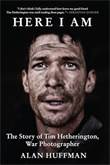
I’ve thought about why I was so affected by this man, this story of Tim Hetherington. It doesn’t hurt that besides being extremely smart, charming, kind, and of excellent character, Tim was also handsome. With all of this, how could one not fall a little in love with him? Clearly everyone – women and men – did. But there’s something else about him that got under my skin, something sad and familiar.
In Junger’s film, there is footage of Tim during his first experience of war in Liberia. Visibly buzzing from shock and adrenaline after a very close-call, he says something about feeling stupid for taking the risk – ‘all for a fucking photograph’. Yet he kept at it, making his way to war-zone after war-zone, with his clunky, old-style camera. He took the risks repeatedly, although his images were primarily faces, portraits of intimacy, capturing something internal, not typical war-action shots.
At a weirdly prescient talk in Moscow given not long before he was killed by mortar shrapnel in Libya, he tells his audience that the odds of staying safe the longer one kept at it, were not good. He knew. He knew early on in his career and yet, compelled, he continued, going closer and closer to the edge. Huffman writes that Tim recognized a pattern of behavior among soldiers and “He also saw the same patterns of behavior in himself. They were all looking for a sense of purpose, which the extremes of war gave them…”
In the film, one of the scenes that moved me the most was Tim with his family. The room brims with love as Tim kisses his mother, embraces, and holds his father. This footage was as affecting for me as the images of violence. He was so loved by family, friends, his stunning, smart girlfriend. Why did he leave them to knowingly move towards death? What did he seek? Yes, he left a powerful body of work behind — but it cannot outweigh the tremendous sense of loss that this fine man is no longer with us — too young. Read Huffman’s book and see Junger’s film and you will feel it too.
Something infects those who go to war – a kind of madness with no apparent cure. An essence of human nature is laid bare only out in those fields, amidst the mortared rubble. The weird and compelling intensity is like no other and impossible to adequately describe to one who has not experienced it. But Junger and Huffman have each done as brilliant a job as their subject did, in their loving, honest portrayals of the remarkable life of Tim Hetherington.
My remarkable friend Naomi in Kyoto, has generously featured a collage of mine on her website’s Chasing Writing in Art link.It’s humbling to be there with so many amazing artists.
Here’s my collage and a few words. Please check out Naomi’s site here.
Return from Journey Collage 1998 24 x 36 inches / approx. 61 x 91 cm
I painted this piece at my home in Connecticut about two years after returning from living and working in a war zone. From June 1992- June 1996, I was with the United Nations Peacekeeping Operation in Former Yugoslavia and UNICEF in Croatia and Bosnia. During that time, I met and married my husband and Molly was born.
I remember setting up my paints in front of the fireplace, imagining I’d capture a peaceful image. Instead, what I see now in this image, is torment. I recall the turmoil and demons we were living with, even as the trappings of our life seemed ideal. It was a struggle for us – especially my husband – to switch gears to a normal life away from war. The supposed tranquility of a chair in front of a fireplace – this scene that should be cozy, looks like the center of a storm.
Indeed, it was.
I still live in this house and love sitting by the fire. Twenty years on since the Balkan wars ended, almost ten since the death of my husband and these days, ghosts have mostly settled and my life is serene. I write more than paint. But I should attempt this interior again to see what would reveal itself. I imagine it would be an image of warmth and peace – butwho knows? The subconscious reveals itself almost in spite of us.
The groundhog is lurking and ravenous as ever. A mysterious volunteer has appeared (does anyone know what this is?) next to the asparagus bed and it must be something good since the bastard has already been munching on it.
We’re trying a new trick this year and it seems to be working: pinwheels. Apparently woodchucks are frightened by shiny, moving things. (Old CDs strung up with fishing line might also work ) So far, so good – these plants are recovering nicely and have yet to be munched on since we set up the spinning sentinels. Yesterday, we visited the dollar shop and loaded up on American flag pinwheels for our own version of homeland security.
Newly planted pea seedlings are pushing through the dirt and a few random bonus patches of lettuce, chard, cilantro and other herbs are emerging from last year. With a fresh layer of topsoil to cover the crumble of leaves ignored last autumn and we’re ready for planting.
For over a decade now, bastard (I’m sure it’s the same one) has been decimating my lettuce, soybeans (a groundhog favorite) broccoli, cucumber, squash – you name it. And every spring, in spite of my previous heartbreaks, I plant again. I refuse to give in to the bastard. For me, it’s become not as much about my wish to harvest vegetables as it is about not giving up. The garden as a metaphor of hope. Worth fighting for.
Why aren’t we terrified to get out of bed in the morning? How is it that we can send our beloved children to venture out into the world on their own? Where do we find the courage when, like this past week in Boston, our world erupts in violence and a fog of fear descends? How is it that even when it is our own disaster, when we are at the epicenter of the storm, we carry on, eventually, finding at least a modicum of joy again?
That light can eventually penetrate the darkest night of the spirit, fascinates and inspires me. Religion is the key for many, but I find no comfort nor convincing explanation there. I’ve seen up close, soldiers wearing the icons of their religions, pumping their AK47s in the air as they sped towards the front line, off to kill and maim under the guise of the superiority of their own belief. The righteousness that religion inspires feels divisive and dangerous to me and personally, I find no comfort in it.
No, what fascinates and moves me is the grace to be found in uncertainty. The ability we have to move on in our not-knowing. To just keep moving. It seems that this is what survivors do – (and we are all eventually survivors) as dark as our individual night might be, instinctually, as long as we might cling to sleep, wish for our own oblivion, eventually, a crack of light breaks through.
It is this transcendence of the human spirit that touches me. Passing through the darkest siege, even with awful losses, violent memories, we continue. Time — terrible, wonderful, time keeps us shifting forward through the bleakest winters, through the insanities of war. And one day, we meet the spring – more beautiful than we remember – we go on, stepping forward, into and beyond the fear. A force of nature, of spirit, of love. A beautiful mystery.